

The Body Asks for Variety
What Research Reveals About Movement and Longevity

Welcome to the Michelle Seguin MD newsletter! I’m Dr. Michelle, and I’m so glad you’re here. This week's letter explores what recent research reveals about movement diversity and longevity, and what it might teach us about living seasonally.
Hello friends,
Earlier this week, I settled in with a cup of tea and a paper that had been sitting in my reading pile. A recent study in BMJ Medicine, following over 110,000 adults across three decades, examining not just how much people moved, but how they moved. The timing feels especially fitting as the 2026 Winter Olympics are underway. Athletes gliding down mountains, spinning on ice, racing through snow. A unifying example of movement diversity and seasonality. The findings from this research changed how I’ve been thinking about movement, health, and what our bodies actually need.
With gratitude,
Dr. Michelle

The Finding
The study followed over 110,000 participants from two large cohorts for more than 30 years. The researchers asked the following question: Does the variety of physical activities matter for longevity, independent of how much people move?
They measured physical activity biennially, capturing specific types: walking, jogging, running, bicycling, swimming, tennis, stair climbing, rowing, weight training. Then they created a “physical activity variety score,” counting how many different types of movement each person consistently engaged in over time.
Here’s what the study showed:
People who engaged in four to five different activities regularly had 19% lower all-cause mortality compared to those engaging in the fewest types of activities
This benefit held even after accounting for total physical activity levels (meaning variety mattered beyond just moving more)
The protective effects extended across causes: 13% to 41% lower mortality from cardiovascular disease, cancer, respiratory disease, and other causes
The people who lived longest weren’t necessarily doing the most exercise (in terms of minutes/duration). They were doing the most kinds of exercise.
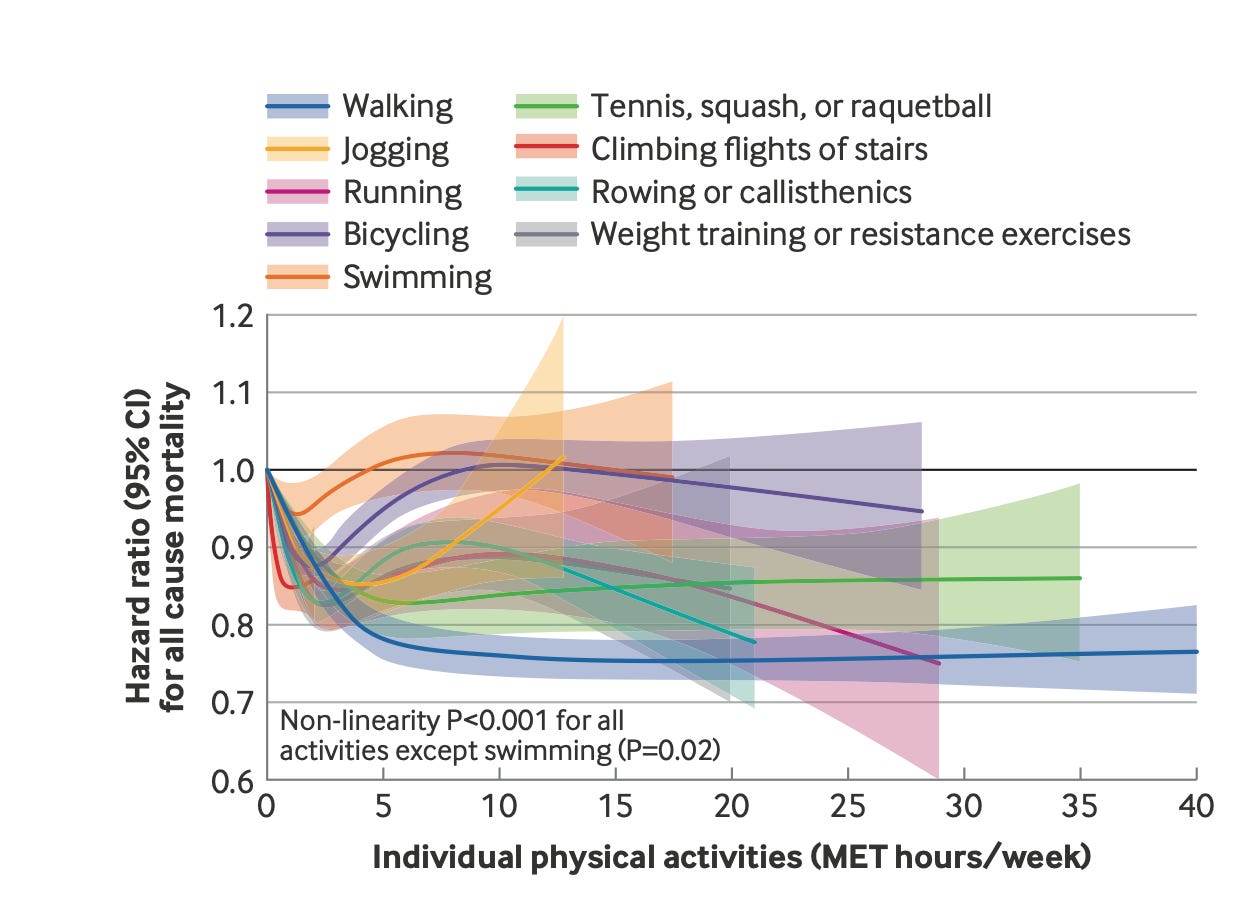
The study also revealed something about individual activities. Most showed a threshold effect, a point where benefits plateaued:
Walking: Benefits plateaued around 2.5 hours per week
Stair climbing: Showed benefits at just 10 minutes daily
Tennis: Benefits plateaued just less than an hour weekly
Weight training: Benefits plateaued around an hour and a half weekly
The body seemed to say: this much is good.
But here’s what mattered: Combining different activities, each within their beneficial range, offered something that volume alone didn’t capture. Someone doing moderate amounts of three different activities (ex: walking, gardening, and weight training) saw greater longevity benefits than someone doing high amounts of just one.
Why might this be? The researchers proposed that different types of physical activity have complementary physiological effects. Aerobic exercise strengthens the cardiovascular system. Resistance training preserves muscle and bone. Activities requiring balance and coordination engage different neural pathways. Each activity asks something different of the body, and the body responds to that diversity with resilience. It’s all connected!
What This Means
We’ve become so focused on optimization. Finding the “best” exercise or most efficient workout. The program that delivers maximum results. But maybe our bodies are asking for something different. Something simpler…
Variety!
Not as a strategy or another thing to optimize. But as a return to something older. What the researchers measured over 30 years is something many traditional cultures have always known intuitively. Our ancestors weren’t optimizing for one perfect activity. They were walking, carrying, digging, climbing, building, dancing. Different movements for different tasks, different seasons, different needs.
The variety wasn’t intentional. It was inherent in how they lived.
Modern life has stripped away much of that natural diversity. We drive and sit instead of walk. And then we try to compensate with programs and optimization, searching for the single best thing to replace what was once many ordinary things.
But the body remembers. It thrives on rotation, on being asked to do different things across time. Different movements for different seasons, days, and needs.

February 6th - Temperature: 11°F. Partly cloudy, winds 2 mph from the northeast. Snow depth: 3+ feet.
First cross-country ski from the back door of the new house. A dream I’ve held for years. The skis cut through the crust but don’t sink. Enough base to hold me up. I cut a trail along the garden edge, into the smaller clearings dotted with pines and serviceberry.
Movement has been lower than I’d like this season, but my legs feel strong. With each kick and glide, I realize something: it takes trust and letting go to glide. You can’t force it. You have to lean into the momentum, release into the forward motion, let the skis (and legs) do what they’re designed to do.
Snow, cold, trees heavy with white. The house visible through bare branches on the return. Movement that belongs to this place, this season, this life.
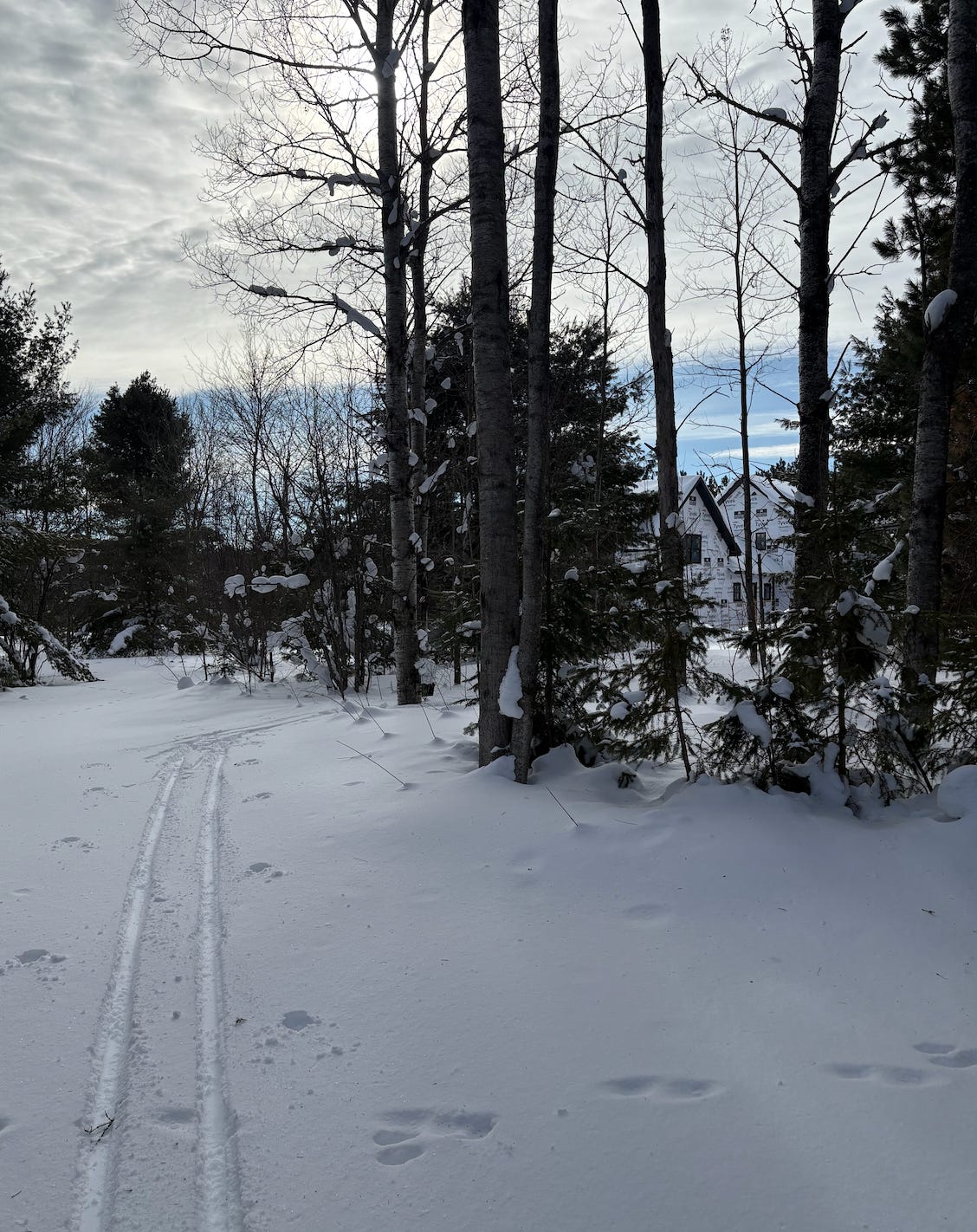
Who I’m becoming: Someone learning that variety in movement isn’t a strategy to optimize. It’s a response to what each season asks for. Someone who understands that gliding requires letting go.
If This Speaks to You
I’m wary of offering absolutes. Your movement will look different than mine. Your seasons, your landscape, your body, your life. All different.
But if this research resonates, here’s what it suggests: rather than optimizing for one thing, consider diversifying. Let the seasons guide variety naturally. Notice what your body asks for on different days.
What the seasons might call for:
Winter - invites snowshoeing, skiing, indoor strength work, stretching/yoga.
Spring - brings gardening, hiking, outdoor work returning.
Summer - opens to swimming, cycling, longer walks/hikes, gentle maintenance.
Fall - asks for harvest work, stair climbing with fall cleanup, transitioning back indoors.These are examples from my life. Yours might look like dancing in your living room, taking stairs at work, walking to the bus, playing with kids or grandkids, or bodyweight exercises at home. The container shifts, but the principle holds: different demands across time.
If you love one activity deeply (running or swimming), this doesn’t mean abandoning it. But perhaps adding something complementary a couple times a week offers benefits you wouldn’t get from just doing more of what you already love. A runner might add weight training. A cyclist might add yoga or walking. Someone who gardens might add deliberate strength work in winter when the garden sleeps.
This seasonal approach naturally fulfills what the guidelines recommend: 150 minutes of moderate aerobic activity and two strength sessions weekly, while weaving in the diversity this research suggests matters. You're not forcing the same routine year-round. You're responding to what each season asks of you, and in doing so, moving through aerobic work, strength building, balance, and flexibility.
Seasonal movement is varied movement!
What Readers Are Saying
I shared this study briefly on Substack Notes earlier this month, and the responses were beautiful. I wanted to share a few reflections that deepened my own thinking.
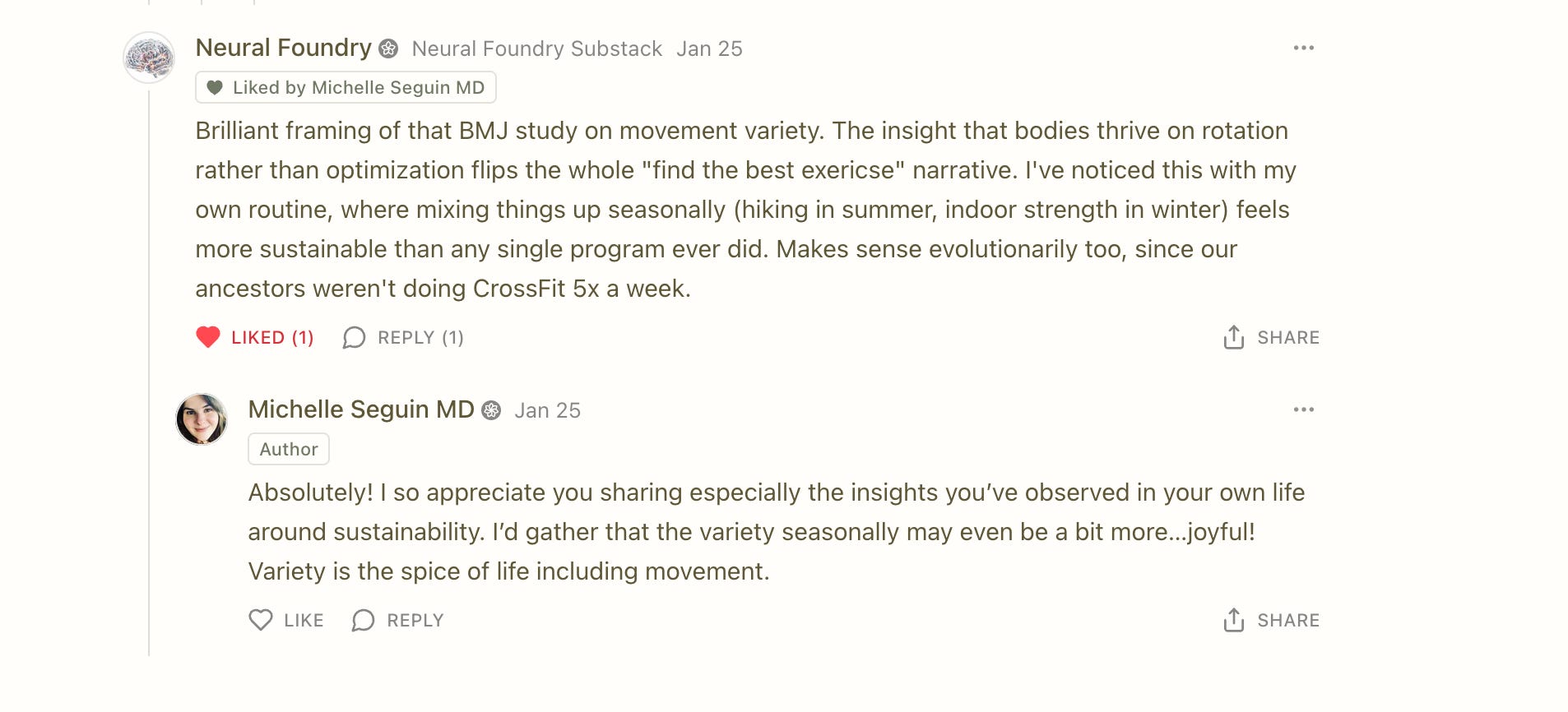
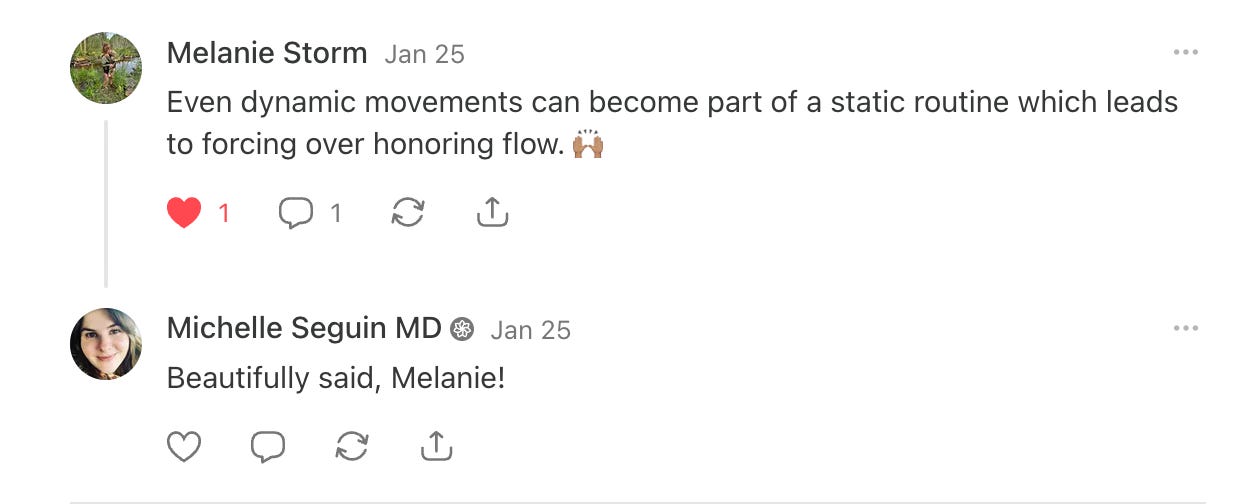

Thank you for engaging with this work. Your insights make this space richer!
If this research resonates with you, I'd love to hear: what does movement diversity look like in your life? How do the seasons shape how you move? Share your thoughts in the comments.
In Closing
The body doesn’t want one perfect thing repeated endlessly. It wants many good things, across time, across seasons. The study gives us language for something we might have already felt: the body thrives when movement varies, when demands rotate, when we trust the seasons to guide us.
With love and care,
Dr. Michelle
P.S. If this letter speaks to you, I'd be grateful if you clicked the heart or shared it with a friend.
Invite your friends and earn rewards If you enjoy this newsletter, share it with your friends. When they subscribe, you'll earn rewards as a thank you.
Here are my most recent Substack sharings:
You write with such an approachable style, Michelle. Reading about issues like this helps all of us focus more on taking care of ourselves.
This post is such a wonderful reminder of what my body already knows! Thank you.