

Register Below the Wind
A Field Note on Birdsong and What it Does to Us

Welcome to the Michelle Seguin MD newsletter! I’m Dr. Michelle, and I’m so glad you’re here. This week, a field note from the front porch of our new home, still becoming, and some thoughts on why birdsong matters, especially now.
Hello friends,
After what felt like the longest January in recent memory, I’m glad to welcome in February. The sunset is nearly 6pm now. For weeks, the dark came so early it felt like the day had barely begun. That extra sliver of light is noticeable. Enough that the birds are louder, or maybe I’m just paying more attention.
With gratitude,
Dr. Michelle

Field notes are a practice of paying attention, returning daily to notice what’s actually happening in your environment and in yourself.
January 31: 19°F. Wind 8 mph WNW. Southern exposure, so the porch was sheltered. I couldn't feel the wind, but I watched it occasionally as snowflakes drifted, then swirled about.
The snow is different now. Warm enough that it crunches again, the way it used to before those weeks of sub-zero temps. A snowy surface that squeaked instead of sang. There is comfort in that shift. A small thaw inside the stillness of winter.
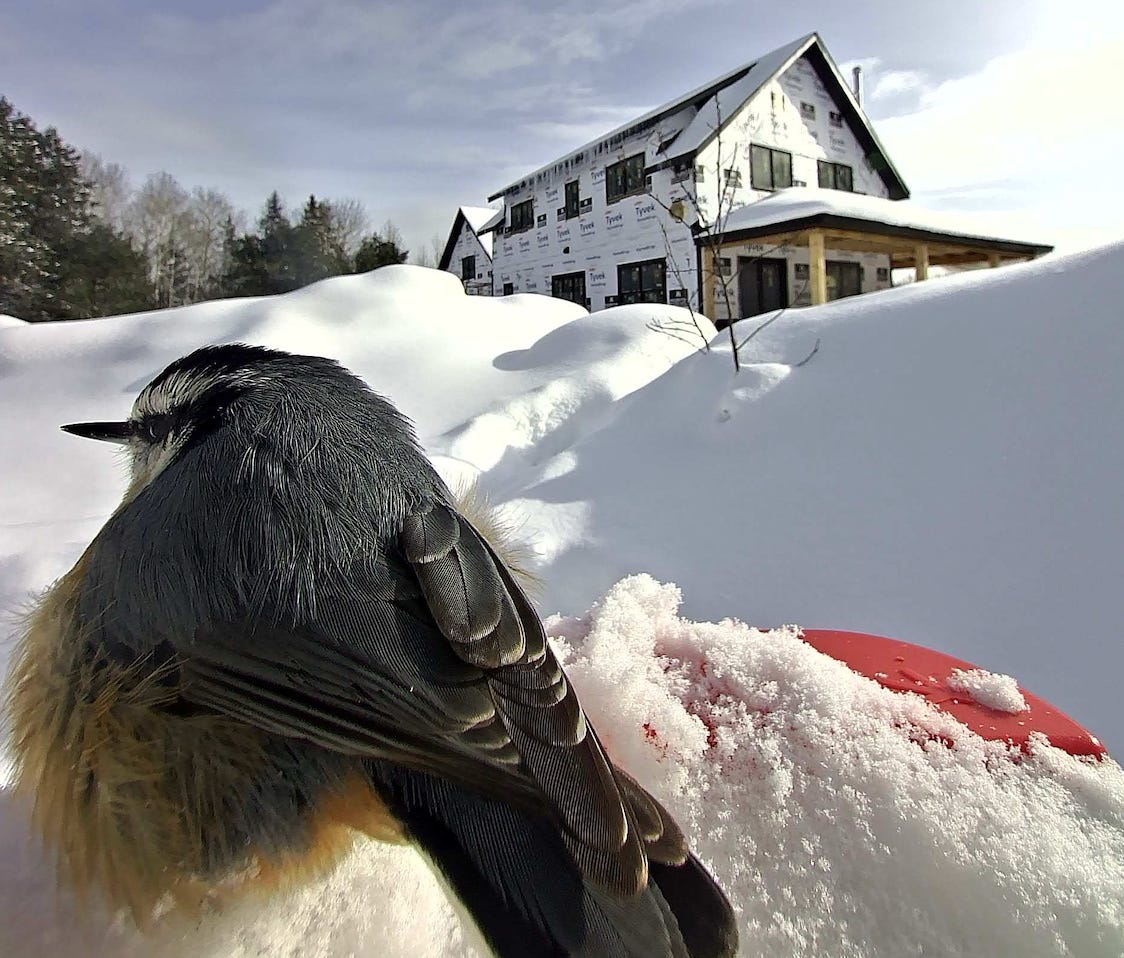
Tea in hand (tulsi rose, for inquiring minds), bundled on the front porch. I sat for a good, long time this morning. The ravens called from above the ridge line. Low, rolling sounds, with a few staccato caws. The chickadees were closer, flitting between the birch trunks, quick and bright. And the red-breasted nuthatches moved down the bark in their unhurried spirals, as if gravity were optional.
And within minutes, my body and mind softened, dropping into a new register. That kind of settling that doesn’t come from doing nothing, but from paying attention to something alive enough to hold you.
It reminded me that even here, in what some would still consider the depths of winter, there is abundant life. Not in spite of the cold, but inside it.
After some much-needed time on the porch, I finished up my errands in town and found myself home with a bowl of pozole from one of my favorite lunch spots. Warming, rich, exactly the kind of meal that asks nothing of you except to enjoy it slowly in your favorite bowl.
FYI - here is a red pozole recipe from Chelsea Lords that looks fantastic!
Who I'm becoming: Someone learning that the porch is not waiting for the house to be finished. Someone who can sit in the cold, listen, and feel held.
Why the Birds Are Singing
There is a summer I think about sometimes. The summer after my first year of college, when I came home and picked up a job at the major retail store in town. I also enrolled in a couple of gen eds through the local community college. One of them led me to write a research paper on birdsong. And that paper, and the questions it stirred, became one of those things that I remember most from that summer.
I’d pack my lunch, my notebook, and a stack of research papers along with a highlighter, and take them to the non-smoking break room. I typically had the room to myself. Most of my coworkers were in the other break room. (The fact that there were two separate spaces is almost unbelievable now even as I write, but it’s true.) Forty-five minutes of quiet akin to a library. A table, a chair, and all the time in the world to wonder.
The question that kept turning in my mind wasn’t just why do birds vocalize? That part seemed straightforward enough. Things like territory, mate attraction, and communication came to mind. But why do they sing? Why not just call, like most animals do? Why produce something that sounds, to our ears at least, like distinct melodies? How did they know these songs? What was innate in their beings, and what was learned, and where was the line between?
Those are questions that don’t have simple answers. And that was part of what made them so compelling. Sitting alone, highlighter in hand, grateful for a full-time job, a community college, and a 45-minute break that felt like a window into something much larger.
What the Research Tells Us Now
The science of birdsong has come a long way since that summer. What we know now is that birdsong lives at the crossing point of the innate and the learned. Young songbirds are born with a genetic predisposition to recognize and respond to the songs of their own species, even before they’ve heard one. But the specific melodies they sing as adults? Those are learned. Young birds memorize the songs of adult tutors during a sensitive window early in life, forming an auditory template in their brains, and then spend weeks refining their own vocalizations until they match. The process is strikingly close to how human infants learn language. A process of listening, practicing, and gradually shaping sound into meaning.
Songbirds are among the very few animals on earth capable of this kind of vocal learning. Not even our closest primate relatives can do it. This makes the chickadee on my porch reel off its little melody something more than a reflex. It is a skill.
But here is what interests me most right now. Not the how of birdsong, but what it does to us when we hear it.
Birdsong and the Human Mind
Two studies have shaped how I’m thinking about this…
The first comes from researchers at the Max Planck Institute for Human Development in Berlin. In a 2022 study published in Scientific Reports, they exposed 295 participants to either birdsong or traffic noise for six minutes. Those who listened to birdsong reported significant decreases in both anxiety and paranoia. And when the birdsong included a higher diversity of species, participants also reported a decrease in depressive symptoms. Traffic noise, by contrast, increased feelings of depression. The researchers’ explanation was this: birdsong functions as a subtle signal that the natural environment around you is intact. An auditory cue of safety.
The second study, from King’s College London, followed 1,300 participants who tracked their daily encounters with birds using a smartphone app. The researchers found that seeing or hearing birds improved mental well-being, and this held true even apart from other nature contact, like being near greenery or water. What struck me most was the duration: the positive effects of a bird encounter lasted for hours afterward. A single chickadee sighting in the morning could still be softening the edges of your day by afternoon.
Neither of these studies is a cure-all. They are not saying birdsong replaces therapy or medication. But together, they point toward something we may have always known intuitively: that the sounds of birds do something real, measurable, and restorative to the human nervous system. And I think we could all use a little bit more of that…
A Few Things Worth Knowing
The Merlin Bird ID app
If you haven’t tried it yet, it is one of my favorite tools for tuning into the birds around you. It can identify birds by their songs in real time, simply by listening through your phone. I especially love it when we’re traveling as it’s fun to learn who's singing in a place you're new to. Worth downloading if you haven’t already.
Bird Buddy feeder
This is our second winter with the Bird Buddy camera feeder, and our whole family loves it. The feeder photographs and identifies birds that visit, and the app sends you a little portrait each time. The chickadees alone have made it worthwhile. This year it has also become a construction cam of sorts, the house always somewhere in the background, so every bird photo is also a small record of the slow becoming of this place. Here's a clip of chickadees including one of their distinct sounds.
A birdsong playlist
For those mornings when you can’t get outside, or when the birds are quiet, or when you simply want to sit with the sound. I found a Spotify playlist of birdsong recordings for your own dose of nature therapy.
Looking ahead: a birdsong dinner.
This one is for the food and nature lovers among you. Granor Farm in Three Oaks, Michigan is hosting a Birdsong Listening Party on March 20, the spring equinox. A seasonal dinner paired with the sounds of birds returning. It feels like exactly the kind of evening this essay is pointing toward. Worth looking into if you're in the area or can make the trip.
Here is an essay I wrote about our truly lovely visit last year.
In Closing
Thank you, as always, for reading along. I hope a thread of birdsong finds you today, wherever you are. I’d love to hear what’s singing where you are, if you called to share.
Readers: What birds are singing where you are right now? Have you noticed them this winter, or are they just beginning to make themselves heard?
With love and care,
Dr. Michelle
P.S. If this brought a little joy to your morning, I’d be grateful if you liked it or shared it with a friend.
Here are my most recent Substack sharings:
Paid subscribers receive access to author-narrated seasonal essays like this one. Perfect to listen to during a winter walk or your weekly meal prep.
The contents of this newsletter are for informational purposes only and are not intended to be a substitute for professional medical advice, diagnosis, or treatment. This newsletter does not constitute a doctor-patient relationship. Always seek the advice of your physician or qualified healthcare provider with any questions you may have regarding a medical condition.
Some links are affiliate links (Bookshop), which means I may earn a small commission at no extra cost to you. This helps support my work.
Keep reading with a 7-day free trial
Subscribe to Michelle Seguin MD to keep reading this post and get 7 days of free access to the full post archives.